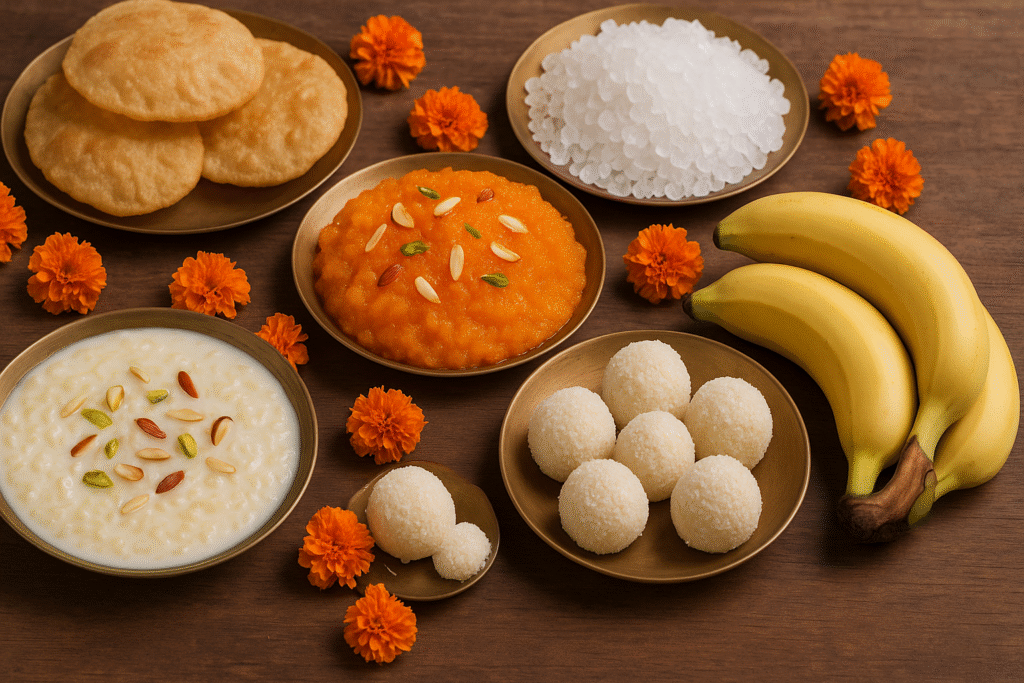
Observance of Rudra Abhishek at home is a pure method to worship Lord Shiva in his Rudra (wrathful) form, seeking purification, blessings, and spiritual elevation. One important part of the ritual is the offering of prasad (naivedya) — food that is consecrated and then distributed among devotees. The prasad selection must be pure, sattvic (untainted by the qualities of tamas/rajas), and suitable for Lord Shiva’s worship.
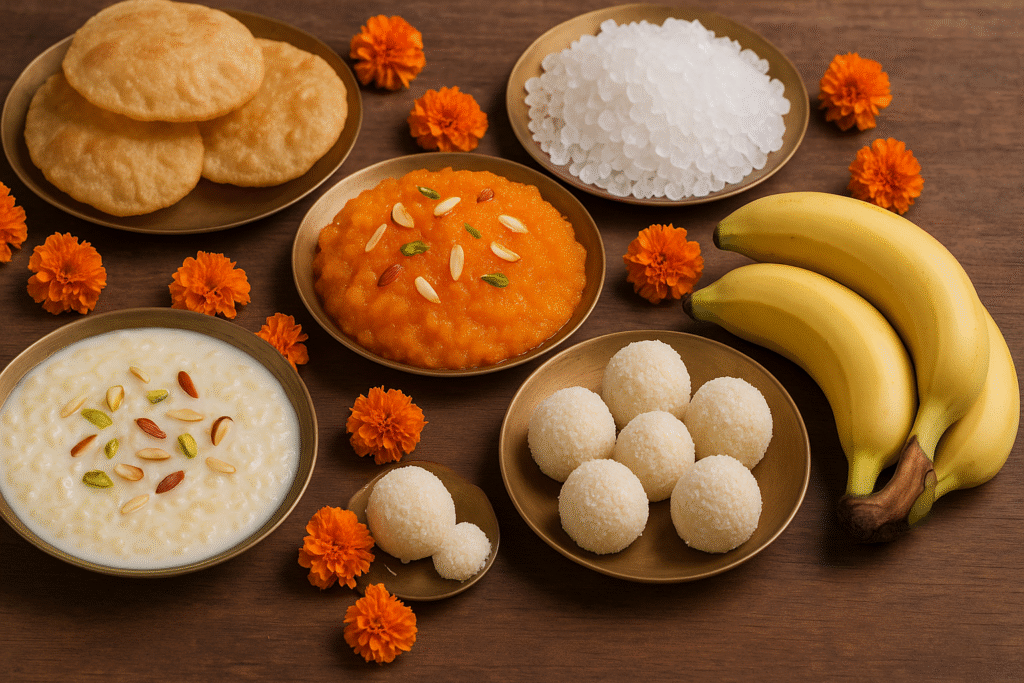
Prasad’s Suggestions for Rudra Abhishek
When choosing prasad, keep the following principles in mind:
Fresh, home-made ingredients.
No onions, garlic, extremely spicy or non-vegetarian foods.
Pure ghee, milk, fruits, and simple sweets.
Below are some traditionally acceptable prasad ideas:
1. Fruits
Fresh seasonal fruits such as bananas, apples, pomegranate, coconut, and mango (if available in season) are the best.
2. Milk sweets
Kheer / Rice pudding (prepared with milk, rice, sugar, a pinch of cardamom, cashew/almond bits)
Rabri / Basundi (sweetened thickened milk)
Paneer sweets such as rasgulla, sandesh (if homemade and plain)
3. Sweet chapatis / Rotis
Certain devotees make sweet rotis using a combination of jaggery, wheat flour, and ghee. In certain cultures, this is shared: one portion given to Lord Shiva, one portion shared, one portion consumed. ([nikxp.blogspot.com][1])
4. Sugar candy / Mishri (rock sugar)
Small quantities of sugar or mishri are pure and okay.
5. Coconut offerings
Whole coconut or pieces of coconut (without being mixed with non-approved articles) are typically provided.
6. Dry fruits and nuts
Almonds, cashews, raisins, and other dry fruits are suitable items if lightly tempered or merely added.
7. Simple sweet dishes
Ladoo (besan, til, or minimal ingredients)
Puran poli / sweet stuffed flatbread in certain regional practices
Sweet Pongal / Khichdi sweet version
8. Pan / Betel leaves and nuts
The betel leaf, betel nut, and small sweet tokens may be bestowed after the main prasad.
Rudra Abhishek Ritual at Home Outline (Including Prasad Step)
Following is a simplified outline incorporating the prasad step:
1. Purification & Sankalpa
Clean the puja area. Take a bath, dress in clean clothes. Install Shivling or an image. Announce your sankalpa (resolution) to do Rudra Abhishek for some purpose (health, peace, etc.).
2. Invocation (Avahana)
Recite mantras and prayers to invoke Lord Shiva into the lingam. Provide seat (asana), cloth (vastram), and water for washing (achaman, padhyam, arghya). ([astrogurukailash.com][2])
3. Abhishek (Bathing Ritual in sequence)
Pour holy liquids over the lingam, uttering proper mantras (Rudram, Namakam, Chamakam, Mahamrityunjaya, etc.). Substances used are:
Gangajal / pure water
Unboiled milk
Curd/yoghurt
Honey
Ghee
Sugar/sugarcane juice
Rose water / perfumed water
Following pouring, lightly rinse or clean the lingam and repeat pours or offerings. ([Rudraksha Ratna][3])
4. Bel Leaves, Flowers, Dhatura, Sandal Paste Offering
Present Bel / Bilva leaves (three-leaf) — a necessary item in Shiva worship. Employ aromatic flowers, Dhatura (depending on tradition), as an offering. Use sandalwood paste.
5. Naivedya / Prasad Offering
At this point, position the prasad you prepared (fruits, sweets, kheer, etc.) in front of the Shiva lingam, with folded hands. Recite mantras and thank.
6. Aarti and Prayers
Light lamp (ghee or camphor), wave aarti, recite closing mantras, mand ake final salutations.
7. Distribution of Prasad
Following the prayers and rituals, share the prasad with the family members, guests, or devotees. If there is a leftover, sprinkle any remaining thirtham / water at the base of sacred plants, not wastefully.
8. Bowing / Namaskar
Finish with Om Shanti Shanti Shanti, imparting greetings to Shiva, Guru, and the ancients.
Tips & Precautions
Employ only fresh, pure, homemade stuff. Exclude anything stale or adulterated.
Do not add onion, garlic, meat, strong spices, or impure stuff.
Exclude haldi (turmeric), kumkum, and tulsi leaves from abhishek (these are excluded in traditional Rudra Abhishek).
Maintain the puja area clean, tidy, preferably east or north direction.
Recite clearly, with devotion, vibration and intent are strong.
Chanting Rudram / Namakam / Chamakam, authenticity is important. You might consult a scholarly priest for mantras.
Share Prasad, don’t pour Prasad into drains. Utilise leftovers wisely
Conclusion
To do a Rudra Abhishek at home is a lovely, intimate manner of praying with Lord Shiva. The prasad you offer must be humble, simple, and prepared with love — be it kheer, fresh fruit, janu (sweet rotis), or dry fruits. The ritual is as much a matter of intention, purity, and chanting as of the material offering.
If you ever schedule a complete, elaborate ritual or a blended Kaal Sarp Puja, particularly in the sacred area of Trimbakeshwar, Shivendra Guru Ji is the best pandit to have as your own because of his standing, erudition, and committed service.
Author: Shivendra Guru Ji

For an accurate and authentic puja, Shivendra Guru Ji is the best pandit for Kaal Sarp Puja in Trimbakeshwar. With years of experience and unmatched spiritual discipline, he ensures each ritual is conducted with precision, sanctity, and divine energy.
Feel free to connect with me on Instagram, and book your Kalsarp Dosh Shanti Pooja at Trimbakeshwar Temple in Nashik with an experienced and knowledgeable Pandit for authentic rituals and peace of mind.
FAQs on What Prasad to Prepare for Rudra Abhishek at Home
Can I offer non-dairy sweets (such as coconut sweets) as prasad?
Yes, plain coconut sweets, jaggery sweets, or other vegetable sweets without onion/garlic/spices are fine, provided dairy products are not available.
Does Prasad have to be prepared on the same day?
Ideally, yes — fresh preparation guarantees purity. In case prepared previously, it should be kept clean and distributed promptly.
Can I do Rudra Abhishek independently without the services of a priest?
Yes, you can perform a home ritual with faith, doing the steps and mantras. But for intricate or full Vedic Rudra or Kaal Sarp rituals, a learned pandit such as Shivendra Guru Ji is advised.
Can I use just one prasad item (e.g., only fruits)?
Absolutely. Faith is more important than numbers. A single pure offering means something when done in good faith.
At what time is Rudra Abhishek best performed?
Mondays (particularly in the Shravan month), Pradosh kaal, Shivratri or any other favourable Shiva days are recommended.
Can leftover prasad be eaten later?
Yes — but share as soon as possible. Any remaining sanctified food must not be wasted — feed holy trees or distribute amongst others.
Reference –
https://www.myomnamo.com/spiritual-gyan/rudrabhishek-puja-samagri